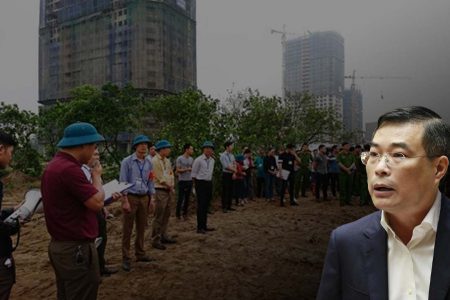
The fact that the capital’s key mega-projects—with a total investment of hundreds of billions of USD, most notably the massive Red River Scenic Boulevard Project costing nearly 28 billion—still do not meet the conditions for groundbreaking under the Construction Law, even after more than half a year, is pushing the Hanoi government into an enormous legal vacuum.
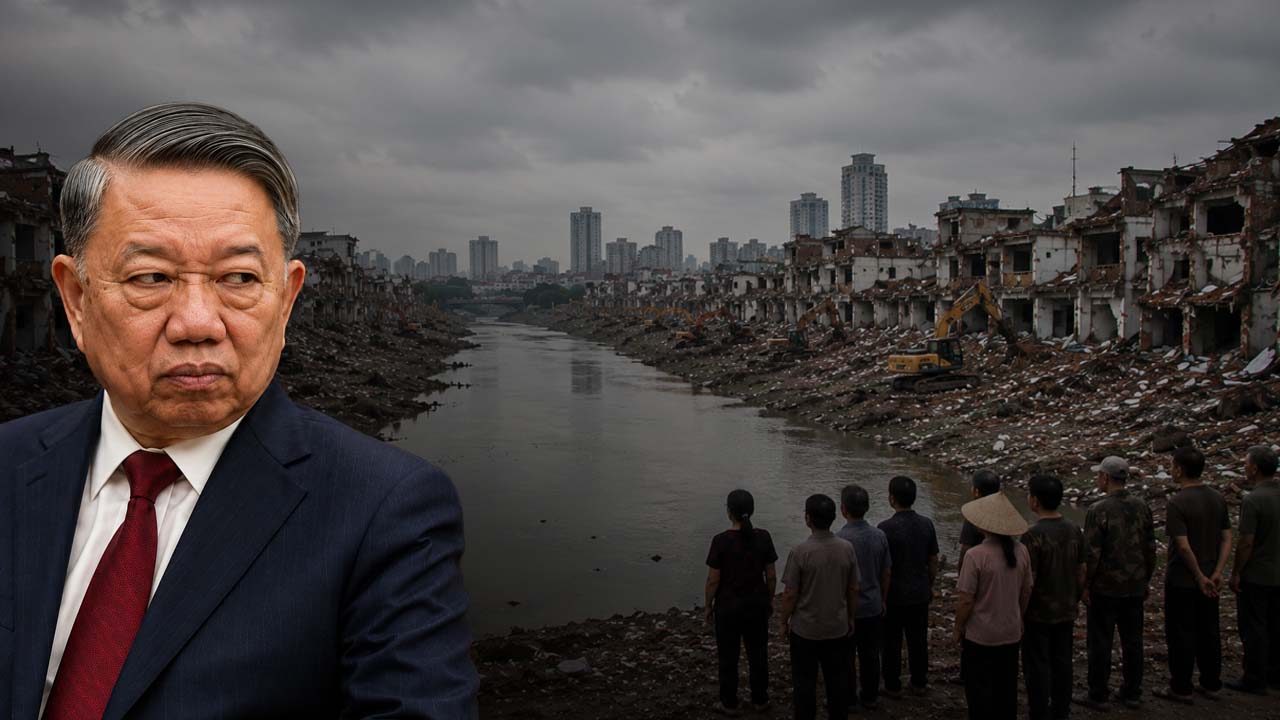
The acceptance of expedited progress through the National Assembly’s continuous extension resolutions not only exposes weaknesses in public governance but also sounds the alarm about a thirst for symbols of power that is undermining planning values.
The goal of demolishing the capital’s entire existing landscape to build a completely new Hanoi on a grand scale—to pave the way for a new era of “dominance and supremacy”—actually masks a purely superficial mindset.
Consequently, the history, culture, and living spaces that have been intertwined for hundreds of years—shared by countless generations of the capital’s residents—are being razed to make way for flashy blueprints on paper.
From the experts’ perspective, using the excuse of “being worthy of its stature” to force everything in Hanoi to change is an unscientific fallacy, because urbanization is never about erasing the past to start from scratch.
A livable city can certainly achieve harmony by placing modern urban areas right next to traditional ancient villages, rather than assuming that creating a distinction requires a complete wipeout in exchange for an entirely new architecture.
Faced with this reality, economist Pham Chi Lan has offered insightful analyses to thoroughly dissect the “out with the old, in with the new” mindset under Mr. To Lam’s administration.
According to Ms. Lan, this is a form of superficiality rooted in social habits: when farmers have money, they build multi-story houses and buy cars to show off, while tycoons feel compelled to drive luxury cars like Rolls-Royces so that business partners won’t look down on them.
Similarly, a city with nothing particularly notable still insists on building a skyscraper as a symbol at all costs. Everyone tries to cram in flashy buzzwords like “International,” “Global,” or “Luxury” to mask a lack of substantive capability.
These phenomena stem from a root cause known as the “inferiority complex”—a consequence deeply entrenched in the feudal social structure, where power must always be accompanied by superficial symbols such as grand mansions or flags filling the sky.
When the poor are oppressed and exposed to such displays for long enough, a mindset takes root in their subconscious: big equals strong, expensive equals prestigious, more equals wealth, and tall equals power.
As a result, instead of investing in core projects, Vietnam’s national budget is squandered on frivolous, symbolic projects designed solely to impress the outside world.
As Vietnamese society enters a new era, this “inferiority complex” mindset has not disappeared—from flaunting houses and cars to boasting about grandiose mega-projects, skyscraper headquarters, or modern-day accolades.
This obsession with trillion-dong mega-projects not only wastes national resources but also reflects the insecurity of those in the highest positions of power—people who are constantly eager to use concrete and rebar to assert their stature in the annals of history.
When urban planning for the capital city of Hanoi is driven by the need for superficial ostentation, the price paid is not only the permanent loss of traditional cultural spaces but also a severe erosion of public trust in the strategic vision of those in charge.
How long will this “inferiority complex” continue to reign in high-level decision-making, where people are willing to burn through hundreds of billions of dollars just to secure a “power-driven ego” to mask the emptiness within?
Trà My – Thoibao.de