These days, as the year-end operational deadline for the mega Long Thành International Airport project draws near, on-site observations show that the contractor consortia are working around the clock to make up for lost time. Thousands of workers are putting in overtime day and night until 9 p.m., and sometimes even as late as 1 or 2 a.m. the following morning.
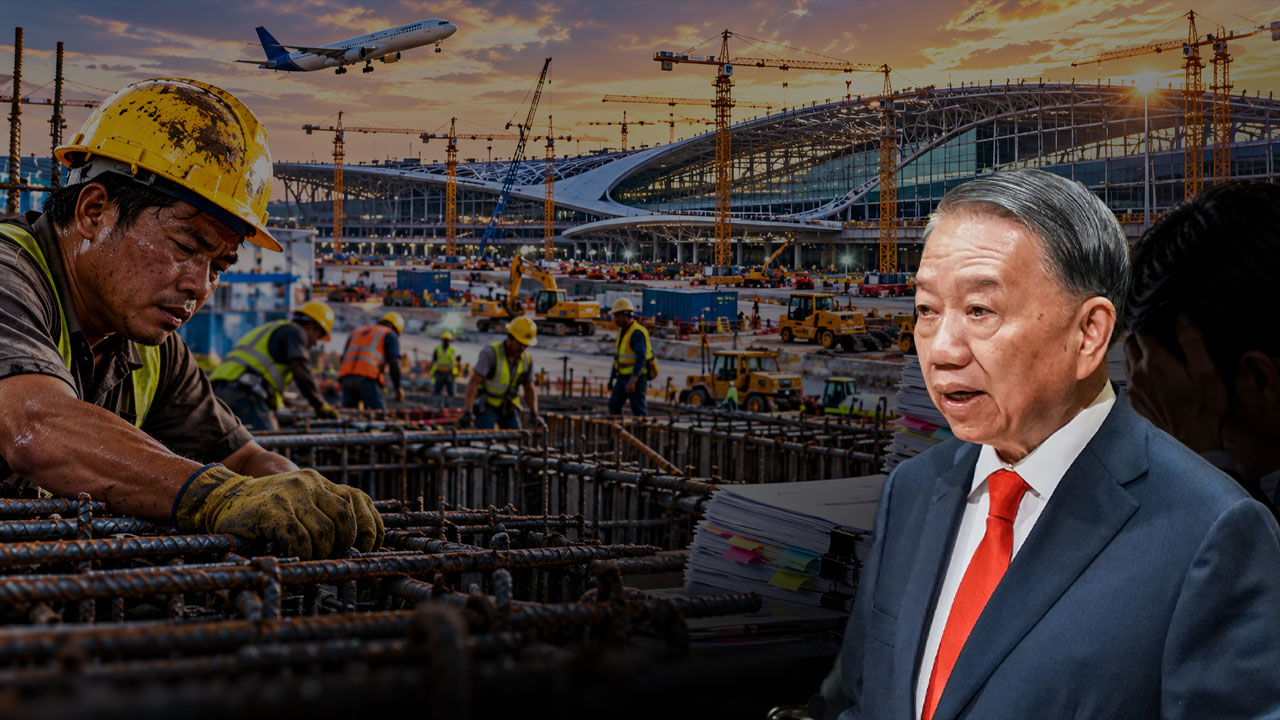
At the parking garage site alone, to keep nearly a thousand workers on the job, the contractor has had to mobilize more than four thousand person-shifts to address the severe shortage of labor and skilled workers.
However, the construction landscape is beset by countless paradoxes as construction material prices are skyrocketing. According to reports from the Ministry of Construction, costs for sand, gravel, asphalt, and other materials have surged by 30 to 70 percent compared to the same period last year, pushing contractors into severe financial distress.
The supply of stone from the Tân Cang quarry cannot keep up with the surging demand, forcing contractors to scramble to find alternative sources.
However, no matter how severe the challenges regarding labor or materials may be, they are merely the tip of the iceberg.
The core issue paralyzing the completion of the Long Thành International Airport Project lies in a legal bottleneck, where thousands of tỷ đồng are currently “frozen.”
According to investigative reports, a deeply troubling situation has emerged: Vietnam Airports Corporation (ACV) sent invitations to six independent inspection agencies to assess the quality of equipment, but received only refusals.
Specifically, a massive legal gray area involving 8,900 tỷ VND is currently stalling the project. The bottleneck stems from changes in equipment model numbers, manufacturers, and countries of origin compared to the original technical specifications approved by the government.
While the contractor has invested capital in construction—with project completion reaching 85 percent and the passenger terminal contract hitting 90 percent—the actual disbursement rate has stalled at just 50 percent.
On one hand, there is the hard work and capital already poured into the construction site; on the other, payments cannot be made due to the lack of a legal basis for conducting final acceptance inspections.
It is precisely at this moment that the issue of accountability becomes the greatest concern for the entire system. Independent inspection agencies have refused to take on the task, as they fully understand the immense legal risks involved in dealing with the original design standards.
Against the backdrop of numerous economic cases involving major project investors being brought to light by the Ministry of Public Security, an atmosphere of extreme caution has engulfed the entire administrative apparatus.
The current management system, with its tight-fisted mechanisms, sometimes inadvertently creates invisible traps, causing anyone who intends to sign off on changing technical specifications to resolve “bottlenecks” to shudder with fear.
According to investigative journalists, at this point, building large-scale international airports is sometimes far simpler than finding someone willing to take responsibility for signing off on a decisive document to resolve the impasse.
As political pressure and committed deadlines race against a rushed schedule, colliding with the Ministry of Public Security’s rigid and high-risk legal framework, the Long Thanh Airport Project has fallen into a state of severe stagnation.
The impasse at the Long Thanh mega-project is sounding a profound wake-up call regarding the “haste makes waste” mentality prevalent in today’s large-scale public investment campaigns.
Without a coordinated and flexible legal framework, all efforts to mobilize resources will only create a vicious cycle of fear and uncertainty in this new era.
Trà My – Thoibao.de
=======
The Current Situation: Is Long Thành Airport “Frozen” Due to Legal Fears That No One Dares to Sign?
“…8.9 trillion VND at Long Thành Airport is stalled due to refusals to conduct inspections, exposing legal barriers stemming from a reluctance to assume responsibility when putting pen to paper.”
#Vietnam #ChinhTruongVN #Thoibao