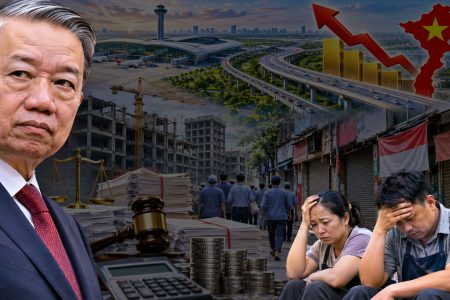
The recent case in Cao Bang, in which a network involved in “bribing” education officials—charging up to 300 million dong per position, with the total amount embezzled exceeding 12 billion dong—was uncovered. This is not merely a criminal case; it is sounding the alarm about a deeply troubling reality in the public sector labor market.

According to state media, the incident has exposed a deeply paradoxical system: there is no such thing as a genuine “backdoor” to begin with; rather, it is all a series of sophisticated traps set by brokers to profit from young people eager to secure a “permanent government position” in remote mountainous regions.
The group of suspects was well aware of the deep-rooted psychology and prejudices held by a large segment of the population—namely, the belief that “one must have money and connections to pass the civil service exam.”
However, in reality, the fact that so many candidates are willing to drain their savings or borrow hundreds of millions of dong to pay these job-brokering rings is the clearest reflection of a crisis in transparency in the recruitment of civil servants and public officials in Vietnam today.
Notably, the prevailing mindset of “first connections, then money” has been fueled by past failures, when many localities were plagued by scandals involving favoritism toward relatives or bribery to secure positions, severely eroding social fairness.
In highland regions or economically underdeveloped areas like Cao Bằng, where job opportunities are scarce, permanent positions in the education or healthcare sectors have effectively become the only lifelines for people to settle down and build a stable life.
It is precisely this brutal pressure of supply far exceeding demand that has inadvertently turned the recruitment environment into fertile ground for criminal activity to thrive.
When candidates lack confidence in their own abilities and are bombarded with promises of “guaranteed admission” or “refunds if you fail,” they come to believe that money is the only way—only to end up losing both their money and their future.
It must be acknowledged that in recent years, the government recruitment system has undergone significant reforms aimed at closing these negative loopholes.
However, the tragedy lies in the fact that even as management systems become increasingly strict and improved, the “money is everything” mentality continues to permeate society, creating conditions for fraud rings to run rampant.
If a truly qualified candidate passes the exam, the fraudsters will simply pocket the deposit and use it as living proof of their so-called “power” to secure jobs through bribery.
Meanwhile, the exposure of such cases not only severely damages the credibility of the government but also discourages honest candidates who wish to contribute to the country.
From a legal perspective, the Criminal Code clearly stipulates severe penalties—up to 20 years in prison or life imprisonment—for the acts of offering bribes, brokering bribes, and fraud to embezzle assets.
Those involved in “job-bribery” networks must realize that, if there is genuine collusion with officials, they are guilty of bribery; if candidates fall victim to fraud, they not only lose their assets but also face the risk of being held liable for violating civil law prohibitions.
It is time for the government to reform the civil service recruitment process, and for society to face the bitter truth that the “job-fixing” mentality is merely fueling a criminal ecosystem that preys on the public’s trust.
Public opinion holds that the government restoring transparency is not enough; the public demands strict adherence to the rule of law with no off-limits zones, where all acts of buying and selling positions or seeking favors must be punished appropriately to restore order and discipline in the nation.
Trà My – Thoibao.de